
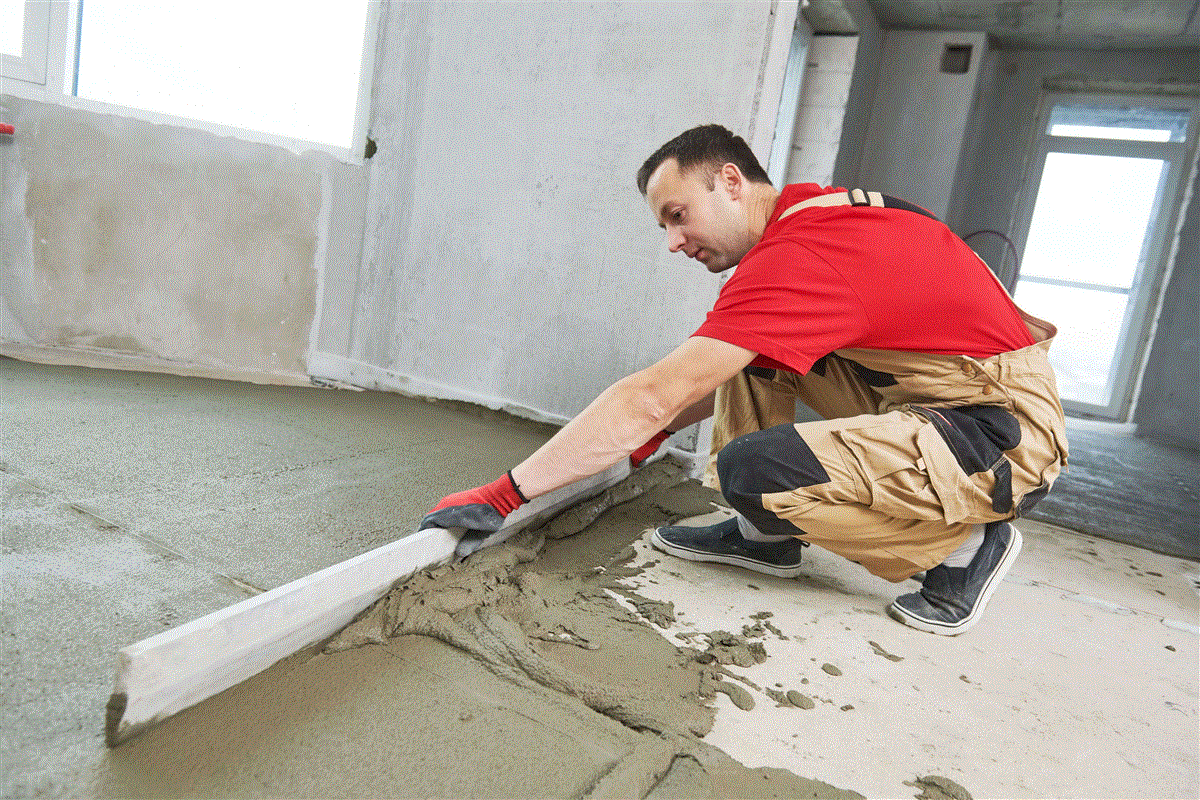
Leveling Screed vs Self-Leveling
What they are
- Leveling Screed (traditional/ bonded or unbonded/semi-dry)
A cement-based screed installed by hand or pumped, compacted and ruled flat. Builds thickness and creates a new structural/installation layer. - Self-Leveling Compound (SLC / self-smoothing)
A flowable, fine aggregate cement/gypsum mix poured thin; it self-levels to achieve high flatness before the final floor.
Typical thickness & purpose
- Leveling Screed: ~30–80 mm (can be thicker). Used to correct big height variations, cover services, create falls, or as substrate for UFH pipes.
- Self-Leveling: ~3–15 mm (occasionally 20–30 mm per product). Used to perfect flatness and micro-level prior to finishes (tile, LVT, wood, resin).
Strength & drying
- Leveling Screed: Higher mass; drying is slower (rule of thumb ~1 week/ cm up to a limit; fast-dry formulas exist). Good for heavy traffic once cured.
- Self-Leveling: Thin layer; cures fast (often walkable in hours). Final coverings require moisture within product limits.
Surface quality (flatness)
- Leveling Screed: Very good when well ruled, but may still need a thin SLC for premium finishes.
- Self-Leveling: Excellent flatness (SR1-grade achievable with correct prep).
Compatibility
- Leveling Screed: Ideal over rough slabs, insulation, DPMs, and for underfloor heating embedding.
- Self-Leveling: Ideal over sound, prepared substrates; can go over existing screeds, concrete, plywood (with primers), UFH (as a finishing layer).
Installation speed & disruption
- Leveling Screed: Slower to place/finish; longer drying before floor installation.
- Self-Leveling: Fast install and turnaround, but requires meticulous substrate prep and priming.
Costs (percentages only; Leveling Screed = baseline 0%)
(Actual percentages vary by country, product type, thickness, access, and prep.)
- Materials per m² at typical thickness
- Self-Leveling (5–10 mm): +20–50% vs baseline (cementitious SLCs are premium per mm).
- Labor & equipment
- Self-Leveling: −10–25% vs baseline for small/medium areas (faster placement); +0–10% on large sites needing pumps/primers.
- Overall program time to floor-ready
- Self-Leveling: −30–60% vs baseline (quicker cure to covering).
- Rework risk (if substrate prep is poor)
- Self-Leveling: +20–40% vs baseline due to sensitivity to adhesion/contamination.
Advantages & best use
Leveling Screed
- Handles large height corrections and build-ups.
- Best for UFH embedding and creating falls/ramps.
- Robust substrate for heavy finishes.
Self-Leveling
- Delivers top-tier flatness for thin finishes (LVT, large-format tile, wood).
- Rapid turnaround; ideal in refurb projects with tight timelines.
- Excellent for spot-corrections and final surface smoothing.
Risks & how to avoid them
- Moisture entrapment (both): Test RH/CM before laying floors; use DPM where required.
- Bond failure (SLC): Poor prep/primer misses → debonding. Fix: mechanical prep, vacuum clean, correct primer.
- Curling/cracking (leveling screed): Over-watered mix or rapid drying. Fix: specified mix, curing control, joints.
- Thickness misuse: SLC too thick or screed too thin. Fix: follow manufacturer min/max; consider fiber-reinforced or fast-dry variants.
- UFH issues: Turning heat on too early. Fix: follow commissioning schedule (gradual heat-up after cure).
Quick choice guide
- Need big build-up, embed UFH, or reshape levels? → Leveling Screed.
- Substrate already close, want perfect flatness fast for a premium finish? → Self-Leveling.

